Thursday, 29 May 2014

The Mad Hatter's Tea Party


In a couple of weeks, I will be providing the tea & cakes at a little local music festival near my home and in preparation for this I have been researching all things tea & cake!  I just couldn’t overlook Alice in Wonderland, the wonderful children’s story by Lewis Carroll!  This is what I found out about The Mad Hatter:

The Hatter (called Hatta in Through the Looking-Glass) is a fictional character in Lewis Carroll's Alice's Adventures in Wonderland and the story's sequel Through the Looking-Glass. He is often referred to as the Mad Hatter, though this term was never used by Carroll. The phrase "mad as a hatter" pre-dates Carroll's works and the characters the Hatter and the March Hare are initially referred to as "both mad" by the Cheshire Cat, with both first appearing in Alice's Adventures in Wonderland, in the seventh chapter titled "A Mad Tea-Party".

The Hatter explains to Alice that he and the March Hare are always having tea because, when he tried to sing for the Queen of Hearts at her celebration, she sentenced him to death for "murdering the time," but he escapes decapitation. In retaliation, Time (referred to as a "Him") halts himself in respect to the Hatter, keeping him and the March Hare stuck at 6:00 forever. The tea party, when Alice arrives, is characterised by switching places on the table at any given time, making short, personal remarks, asking unanswerable riddles and reciting nonsensical poetry, all of which eventually drive Alice away. He appears again as a witness at the Knave of Hearts' trial, where the Queen appears to recognise him as the singer she sentenced to death, and the King also cautions him not to be nervous "or I'll have you executed on the spot."
When the character makes his appearance as "Hatta" in Through the Looking-Glass, he is in trouble with the law once again. This time, however, he is not necessarily guilty: the White Queen explains that quite often subjects are punished before they commit a crime, rather than after, and sometimes they do not even commit it at all. He is also mentioned as being one of the White King's messengers, and the March Hare appears as well as "Haigha", since the King explains that he needs two messengers: "one to come, and one to go." Sir John Tenniel's illustration also depicts him as sipping from a teacup as he did in the original novel, adding weight to Carroll's hint that the two characters are very much the same.
Although the name "Mad Hatter" was clearly inspired by the phrase "as mad as a hatter", there is some uncertainty as to the origins of this phrase. Mercury was used in the process of curing felt used in some hats, making it impossible for hatters to avoid inhaling the mercury fumes given off during the hat making process; hatters and mill workers thus often suffered mad hatter disease, mercury poisoning causing neurological damage including confused speech and distorted vision.
Hat making was the main trade in Stockport, near where Carroll grew up, and it was not unusual then for hatters to appear disturbed or confused; many died early as a result of mercury poisoning. However, the Hatter does not exhibit the symptoms of mercury poisoning, which include "excessive timidity, diffidence, increasing shyness, loss of self-confidence, anxiety, and a desire to remain unobserved and unobtrusive."
The Hatter and the March Hare are initially referred to as "both mad" by the Cheshire Cat, and both first appear in the seventh chapter of Alice's Adventures in Wonderland, which is titled "A Mad Tea-Party"
And if that inspires you, head to The Sanderson Hotel for a very upmarket Mad Hatter’s tea party:


Or come and join us at Sherston Fest 2014!


http://sherstonfest.com/

Wednesday, 14 May 2014

Birthday cake dilema!

What do you do when you have a child that is
fussy about cake?


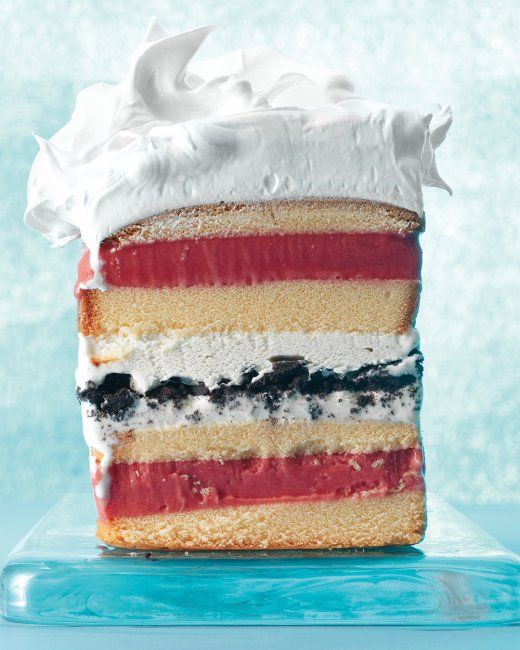
Earlier this month I had this very dilemma, as I do every year in May when the time comes to plan for my dearest (middle) child’s birthday.  Thankfully this year, I stumbled upon this inspirational image and fantastic recipe.  Of course with him being fussy about cake meant that I had to adapt the flavour combinations of this idea, but I’m pleased to say that my, Ginger cake, Lemon sorbet & Vanilla ice cream version went down a real treat!


7 layer Ice-cream cake

INGREDIENTS

  • 1 frozen pound cake (10 3/4 ounces) in aluminum loaf pan, un-thawed, or 1 homemade 4 1/2-by-8 1/2-inch pound cake, room temperature
  • 2 cups raspberry sorbet, softened
  • 1 cup vanilla ice cream, softened
  • 1/2 cup coarsely chopped chocolate wafer cookies
  • 2 large egg whites
  • Cream of tartar
  • 1/2 cup sugar
  • 1/2 teaspoon pure vanilla extract

DIRECTIONS

STEP 1

Remove cake from pan and cut horizontally into 4 slices. Line pan with plastic wrap, leaving 6-inch overhang on two sides. Build cake layers in pan in this order: bottom cake slice, 1 cup sorbet, cake slice, 1/2 cup ice cream, cookie crumbs, 1/2 cup ice cream, cake slice, 1 cup sorbet, top cake slice. (If necessary, return ice cream to freezer as you work.) Wrap in plastic and freeze at least 1 hour (or up to 3 days).

STEP 2

In a heatproof bowl, lightly whisk together egg whites and pinch of cream of tartar. Set bowl over (not in) a pan of simmering water and whisk until whites are foamy. Slowly whisk in sugar and cook, whisking, until sugar is dissolved (to test, rub some between your fingertips).

STEP 3

Remove bowl from heat and, with an electric mixer, beat on medium-high until stiff, glossy peaks form, about 6 minutes. Add vanilla and beat 1 minute. Remove cake from pan, trim sides if desired, and dollop meringue on top.

  * * * * *

If all else fails, forget the ice cream, hollow out a cake & fill the damn thing up with sweets!

DIY Pinata cake!


But if they really don’t like cake in any capacity, then you could, of course do away with the cake altogether and try one of these instead, (at least they look like cakes)!


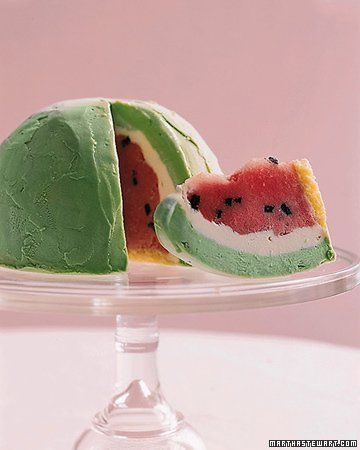
Watermelon Bombe, (with chocolate chips).
A funky idea for both boys and girls!


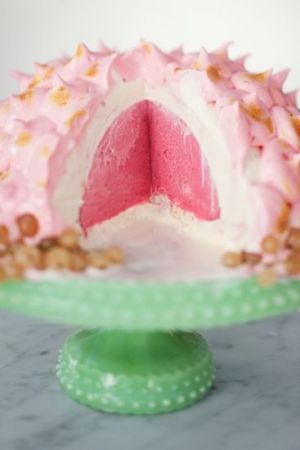
Ice cream bombe with raspberry meringue

Lovely and girly, this dessert can be prepared a few days before a party. Then let the ice cream bomb (without the meringue) soften in the refrigerator for about 20 minutes, until you can slice it. Turn it out onto a serving tray. Then freeze the ice cream bomb for 10 minutes so the surface can harden so the meringue doesn’t fall off. You have to work fast when you pipe the meringue since the ice cream melts. You will need a blow-torch to cook the meringue.
  • 2 litres softened vanilla ice cream
  • ¾ litre softened raspberry sorbet
  • 1 cake base (purchased is fine)
  • 1 small (¾ litre) and 1 large (2 litres) metal bowls

Raspberry meringue

  • 3 free-range egg whites
  • 4 drops fresh lemon juice
  • 325 ml sugar
  • 200 g fresh raspberries

  1. Freeze the bowls (so the ice cream sticks better to the sides and does not melt as quickly when the bowls are to be filled).
  2. Soften the sorbet in the refrigerator for 20-30 minutes. Pack it firmly into the little metal bowl. Cover with cling film and freeze it until the sorbet is hard again, about 2 hours.
  3. Soften the vanilla ice cream in the refrigerator for 20-30 minutes. Cover the bottom and walls of the larger (frozen) metal bowl with vanilla ice cream so you leave the centre hollow.
  4. Take the bowl with the raspberry sorbet out and rinse the outside of the bowl quickly with hot water. Take the sorbet out and press it into the hollow space in the vanilla ice cream. Fill in any excess space with more vanilla ice cream and spread a layer of vanilla ice cream on top so the sorbet disappears into the middle of the bomb.
  5. Cut a round slice out of the cake bottom so it covers the entire surface of the ice cream. Cover with cling film and freeze again until the ice cream bomb is hard.
  6. Rinse the outside of the bowl quickly with hot water and press the ice cream out. Freeze it again so the surface freezes.
  7. Whisk the egg whites, lemon juice and 1 dl sugar with an electric mixer into a thick meringue in a dry and clean stainless steel bowl.
  8. Add another 1 dl sugar while whipping it.
  9. Mash the raspberries with the rest of the sugar and whip it into the meringue at low speed. Whip it hard until it is firm.
  10. Pipe or spread the meringue over the ice cream bomb and cook the surface with a blow-torch.

Monday, 28 April 2014

The Tea Act

The Tea Act was an Act of the Parliament of Great Britain. Its principal over objective was to reduce the massive surplus of tea held by the financially troubled British East India Company in its London warehouses and to help the struggling company survive. A related objective was to undercut the price of tea smuggled into Britain's North American colonies. This was supposed to convince the colonists to purchase Company tea on which the Townshend duties were paid, thus implicitly agreeing to accept Parliament's right of taxation. The Act granted the Company the right to directly ship its tea to North America and the right to the duty-free export of tea from Britain, although the tax imposed by the Townshend Acts and collected in the colonies remained in force. It received the royal assent on May 10, 1773.
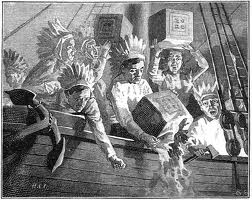
Colonists in the Thirteen Colonies recognized the implications of the Act's provisions, and a coalition of merchants and artisans similar to that which had opposed the Stamp Act 1765 mobilized opposition to delivery and distribution of the tea. The company's authorised consignees were harassed, and in many colonies successful efforts were made to prevent the tea from being landed. InBoston, this resistance culminated in the Boston Tea Party on December 16, 1773, when colonists (some disguised as Native Americans) boarded tea ships anchored in the harbour and dumped their tea cargo overboard. Parliamentary reaction to this event included passage of the Coercive Acts, designed to punish Massachusetts for its resistance, and the appointment of GeneralThomas Gage as royal governor of Massachusetts. These actions further raised tensions that broke out into the American War of Independence in April 1775.
Parliament passed the Taxation of Colonies Act 1778, which repealed a number of taxes (including the tea tax that underlay this act) as one of a number of conciliatory proposals presented to the Second Continental Congress by the Carlisle Peace Commission. The commission's proposals were rejected. The Act effectively became a "dead letter", but was not formally removed from the books until passage of the Statute Law Revision Act 1861.

Tuesday, 22 April 2014

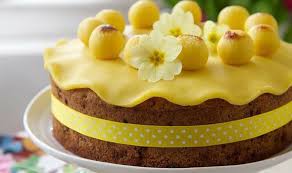
Simnel Cake


Simnel Cake was not originally baked at Easter but on Mothering Sunday as a kind of mid-Lent treat.

Simnel cake is a light fruit cake, similar to a Christmas cake, covered in marzipan, and eaten at Easter in England and Ireland. A layer of marzipan or almond paste is also baked into the middle of the cake. On the top of the cake, around the edge, are eleven marzipan balls to represent the true apostles of Jesus; Judas is omitted. In some variations Christ is also represented, by a ball placed at the center.
The cake is made from these ingredients: white flour, sugar, butter, eggs, fragrant spices, dried fruits, zest and candied peel.The French version of this cake is more of a Bun or muffin size and decorated with sugar crosses on top. These were their equivalent of the English Hot Cross Bun.
Simnel cakes have been known since medieval times, and were originally a Mothering Sunday tradition, when young girls in service would make one to be taken home to their mothers on their day off. The word simnel probably derived from the Latin word simila, meaning fine, wheaten flour with which the cakes were made. A popular legend, however, attributes the cake’s creation to the English pretender Lambert Simnel, who according to legend devised it during the time in which he was forced to work in Henry VII’s kitchens.
Different towns had their own recipes and shapes of the Simnel cake. Bury, Devizes and Shrewsbury produced large numbers to their own recipes, but it is the Shrewsbury version that became most popular and well known.

Ingredients
1 x 500 g pack golden marzipan
3 level teaspoons baking powder
1 rounded teaspoon mixed spice
1 x 411 g jar mincemeat
12 oz (350 g) mixed dried fruit
1 x 250 g pack ready-to-roll icing
Pre-heat the oven to gas mark 6, 400°F (200°C) to roast the almonds, then lower it to gas mark 2, 300°F (150°C) when you come to cook the cake.


Equipment
You will also need an 8 inch (20cm) round loose-based cake tin, greased with base and side lined.

Method

You need to begin by toasting the almonds to give them some extra crunch and flavour. So spread them out on a baking sheet and pop them in the pre-heated oven for 8-10 minutes. Don't guess the time, please use a timer – they need to be lightly toasted to a golden brown colour and you could end up with an expensive mistake if you try and guess! Now remove the almonds and reduce the oven temperature to gas mark 2, 300°F (150°C).Then, when the almonds are cool, chop them roughly.
Next unwrap the marzipan, cut the block into two halves, re-wrap one of them for use later and chop the remaining half into ½ inch (1 cm) cubes. Toss them in 1 tablespoon of the flour from the cake. Now for the cake. Take your largest mixing bowl, sift the flour, baking powder and spice in, then simply place all the ingredients, except the marzipan, icing sugar, icing, redcurrant jelly and egg yolk, into the bowl. Then, take an electric hand whisk for preference or, failing that, a wooden spoon, and give everything a really good mixing – which will take about 2-3 minutes – to get it all perfectly and evenly distributed. Finally, gently fold in the squares of marzipan and any remaining flour.
Now, using a rubber spatula, spoon the mixture into the prepared tin, levelling the surface with the back of the spatula. Place a suitably sized square of double greaseproof paper with a hole the size of a 50p piece in the centre over the top. Place the cake on the centre shelf of the oven and bake for 2¾-3¼ hours at the lower temperature of gas mark 2, 300°F (150°C). Have a look after 2¾ hours – the cake is cooked when the centre feels springy when lightly pressed. When it is cooked, leave it in the tin for 30 minutes before turning it out on to a wire rack to cool.
For the decoration, first dust a working surface with icing sugar and roll out the icing to the same size as the top of the cake (you can use the base of the tin as a guide here). Then brush the top of the cake with redcurrant jelly and fit the icing on top of the cake, pressing it securely all round and using a rolling pin to level it as much as possible. Trim off any overhanging pieces. Roll out the reserved marzipan to a rectangle about 9 x 6 inches (23 x 15 cm), then cut it into 12 long strips about ½ inch (1 cm) wide for the lattice topping.
Assembling the lattice goes as follows: first lay half the strips across the cake, leaving about ¾ inch (2 cm) gap between each strip. Then begin to thread the rest of the strips, one at a time, under and over the first ones, going at right angles. Finally, use some scissors to snip the overhanging marzipan away and press firmly all round to make the edges as neat as possible.
Now pre-heat the grill, and when it's really hot (it will take at least 10 minutes to come up to full blast), brush the marzipan strips with the egg yolk and place the cake under the grill, about 4 inches (10 cm) from the heat. Give it about 30 seconds, watching it like a hawk, until it turns a toasted brown colour. The cake is now ready to serve or be stored. It looks very pretty if you tie a ribbon round the circumference and decorate with some Easter flowers.

Wednesday, 19 March 2014

Purple day - 26th March 2014


http://maggieaustincake.com/

On 26 March a charity called Young Epilepsy will be celebrating International Purple Day.
The charity advocates better futures for young lives with epilepsy and associated conditions and Purple Day aims to raise both funds and epilepsy awareness.

How about getting inspired by baking some yummy purple goodies?  If you have questions, want more information or just want to talk through your ideas call them on 01342 831 245 or emailfundraising@youngepilepsy.org.uk – they’d love to hear from you!

Always a favorite with my children are Blueberry Muffins.  In my opinion, much more tasty than the chocolate chip version, (and a sneaky way of getting some fruit inside them)!

 Here is a really easy recipe that I use from time to time:

Blueberry Muffins


Ingredients  (Serves 1 - 10 Muffins)

  • 60g butter
  • 115g Caster Sugar
  • 2 medium eggs
  • 250g Plain Flour
  • 2 tsp Baking Powder
  • 125ml milk
  • 150g blueberries
  • Pinch of salt
  • Muffin cases and tray

Method

Cut the butter into small cubes. Put in a mixing bowl together with Caster Sugar. Use a wooden spoon to cream the two together.
Crack and add one egg, beating it into the mixture. When the egg is absorbed, repeat the process with the second egg.
Put the flour, baking powder and a pinch of salt into another mixing bowl and gently sift together.
Now add small amounts of the "dry flour" mixture and the milk to the original mixture, giving a good stir each time Keep doing this until all the "dry flour" and milk has been used up, and the mixture is smooth.
Finally add blueberries and stir well
Line the tray with muffin cases and spoon in the mixture. Bake in an oven preheated to gas mark 4 (or 180 degrees celsius) for twenty-five minutes.